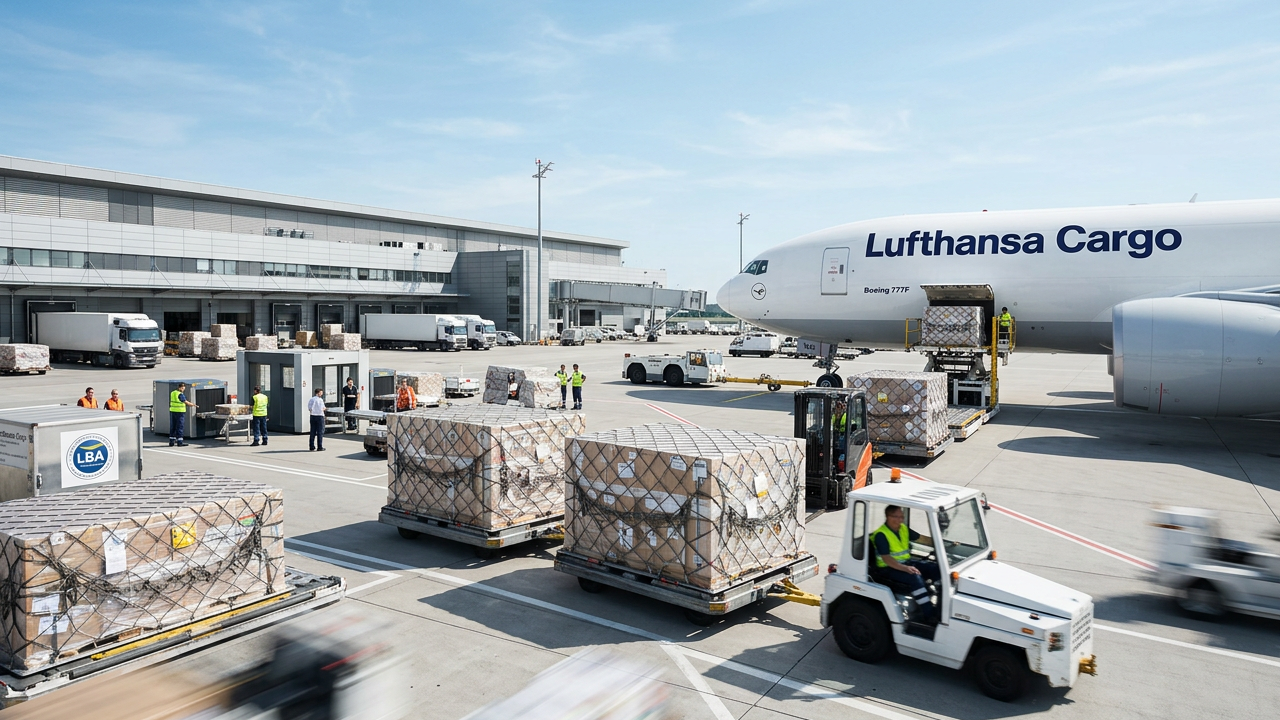
/assets/images/3/Teaser_LBA_1-9rq9at8fg1z6fzh.png

Achieving known consignor status – customs-compliant, without airport delays, and LBA-certified

Secure your air freight supply chains and eliminate expensive screening fees at the airport. We guide your company safely and efficiently through the Federal Aviation Office (LBA) approval process to become an official "known consignor."

Fast processing, predictable delivery times – secure your air freight ex works

In international air freight, every minute counts. Any company delivering cargo to the airport without a special security status must expect significant delays and additional costs: each package must undergo time-consuming and expensive X-raying, physical searches, or explosive trace detection before being loaded.

The solution is the "known consignor" (KC) status, officially granted by the German Federal Aviation Office (LBA).

With this certification, your cargo is already deemed "secure" at your production or warehouse location. It is loaded directly at the airport without any additional security screening. For internationally active companies, the known consignor status is a massive competitive advantage that accelerates supply chains, reduces costs, and guarantees reliability for customers worldwide.

/assets/images/d/LBA_758x758-4209h2xh716mhq7.png
Your business benefits: Speed and cost savings

Investing in known consignor status usually pays off quickly. The financial and operational benefits are directly measurable:

  • No screening fees: You save on the high costs of X-raying, sniffer dogs, or visual inspections at the airport.
  • Predictable just-in-time deliveries: No unpredictable waiting times or delays during airport handling.
  • Protection of sensitive cargo: Avoid damage caused by opening or improper handling of packaged goods during manual secondary security checks.
  • Reputation boost: Position yourself with major global customers and logistics partners as a trustworthy link in a secure supply chain.
/assets/images/6/LBA_Leistungen_758x758-1msa778md7dcsdm.png
Our Service

We guide your company step-by-step through the entire approval process, handle the documentation, and prepare you optimally for the official LBA audit.

Assessment & Security Check

  • Site audit: Review of your warehouse and production areas regarding structural and organizational security requirements.
  • GAP analysis: Identification of vulnerabilities in access controls, personnel processes, and goods receipt/dispatch.
  • Project scoping: Defining the exact scope for the subsequent LBA approval.

Creation of the Aviation Security Program (ASP)

  • Document creation: Conceptualization and drafting of your tailored security program in accordance with official LBA templates.
  • Process integration: Linking security requirements with your existing quality management (ISO 9001) or information security management systems (ISO 27001).
  • Authority management: Submitting the program to the LBA and handling all communication regarding inquiries or requested adjustments.

Employee Empowerment & Aviation Security Officers

  • Background check support: Assistance in applying for background checks (ZÜP) in accordance with § 7 of the German Aviation Security Act (LuftSiG) for your employees.
  • Training coordination: Organization of legally required training (e.g., for aviation security officers and staff with access to cargo).
  • Work instructions: Creation of clear, easy-to-understand checklists for your logistics employees in their day-to-day operations.

Audit Preparation & LBA Support

  • Pre-audit (dry run): Simulation of the LBA on-site inspection to eliminate any weak points in advance.
  • Inspection support: Personal guidance and support during the official audit conducted by the LBA inspector at your site.
  • Post-audit support: Assistance in implementing any official requirements until the final issuance of your approval number.

What makes us strong:

Experience & expertise

Audit-proof. Experienced. Proven in practice.

The German Federal Aviation Office (LBA) approval process tolerates no formal errors. As experts in governance, risk, and compliance, we bring the necessary process expertise to submit applications flawlessly.

  • In-depth insider knowledge: We know the exact audit criteria and interpretation guidelines used by LBA inspectors.
  • Holistic security: We view physical security, personnel security, and information security as a single, unified entity.
  • Track record of success: Numerous successfully supported certifications and audits within regulated environments.
Industry focus & practical relevance

Pragmatic logistics processes instead of bureaucratic standstill

Security measures must be seamlessly integrated into daily logistics operations without slowing down the flow of goods.

  • Focus on industry & export: Tailored consulting for medium-sized manufacturing companies, OEMs, and global shippers.
  • Cost-effective solutions: We only plan structural changes where they are strictly necessary and required by the LBA.
  • Hands-on clarity: We translate cumbersome legal texts into simple, practical work instructions for your warehouse staff.
Full-service support

Your path to approval – from the initial site inspection to the LBA approval number

The approval process ties up internal resources. We support your logistics and quality managers so they can focus on their core business.

  • Step 1: On-site current-state analysis – We uncover vulnerabilities before the LBA inspects the location.
  • Step 2: Conceptualization & ASP – We draft your turnkey security program and manage the submission process.
  • Step 3: Personnel preparation – We steer the entire process regarding background checks (ZÜP) and training.
  • Step 4: The LBA audit – We stand right by your side during the official audit to professionally handle inquiries.

Accelerate supply chains – request your LBA approval consultation now

For further information on data processing activities upon use of our contact form, please refer to our privacy policy.

FAQ – LBA

What exactly is the difference between a "known consignor" and a "regulated agent"?

The known consignor (KC) is the origin of the secure supply chain – meaning the company that manufactures or packages the goods (e.g., an industrial or export company). The regulated agent (RA) is typically the logistics service provider, freight forwarder, or airport agent that transports, stores, or handles the cargo classified as secure. Both must be certified by the LBA to ensure the supply chain remains seamlessly secure.

How long does the entire LBA approval process take?

The total duration depends heavily on the structural condition of your site and the processing time at the LBA. As a rule, you should expect 4 to 9 months for the entire project – from the initial assessment and the creation of the Aviation Security Program (ASP) to the completion of employee background checks (ZÜP) and the final on-site LBA inspection.

Who in the company needs a background check (ZÜP / Zuverlässigkeitsüberprüfung)?

The Zuverlässigkeitsüberprüfung (ZÜP) is a legally required security background check in Germany.

A background check (ZÜP) pursuant to Section 7 of the Aviation Security Act (LuftSiG) is mandatory for all individuals who have direct access to identifiable air cargo or perform security controls. This includes employees in the warehouse, packaging, and shipping departments, as well as the designated Aviation Security Officer and their deputy, plus any IT or cleaning staff with access to these areas.

Do we need to remodel our entire company premises to achieve this status?

No, usually not. The security requirements primarily apply to the areas where air cargo is packaged, stored, or prepared for shipment (so-called "security areas"). Often, organizational measures, clear access restrictions (e.g., via keycard), fencing, or installing lockable gates and CCTV monitoring at critical points are entirely sufficient.

How long is the approval as a Known Consignor valid for?

The approval granted by the Federal Aviation Office (Luftfahrt-Bundesamt – LBA) is valid for a maximum of 5 years. Prior to the expiration of this period, a new on-site inspection (recertification) must be conducted by the LBA. Independent of this, the LBA may also perform unannounced spot checks at your facility during the current validity period.

Is the status worth it for companies with low air freight volumes, too?

This can be determined across the board through a cost-benefit analysis. Key considerations include the costs of airport security screenings (X-ray fees, etc.), the costs of delivery delays, and the internal effort required for the certification. The status usually pays off if you have a regular, weekly volume of air freight, or if your overseas customers contractually require absolute just-in-time deliveries.

Can we combine Known Consignor (bV) status with the AEO certificate (customs)?

Yes, this is actually very advantageous. If you already hold Authorized Economic Operator status (AEO-F or AEO-S), the LBA often recognizes certain physical security requirements for your facility as already fulfilled. This significantly accelerates the application process for Known Consignor status, as synergies can be used to their full potential.